Open Nav


Organic-inorganic composite thermoelectric materials not only possess the advantages of organic materials—such as light weight, high ductility, low cost, and ease of preparation—but also can achieve thermoelectric performance that is superior to that of pure organic materials. As a result, they have continuously attracted significant attention in recent years. However, conventional organic/inorganic composite thermoelectric materials prepared by in-situ polymerization or mechanical blending suffer from several issues: inorganic nanoparticles are difficult to disperse, prone to oxidation, hard to control in terms of particle size, and often require an excessive amount of inorganic phase (typically >25 wt%). These problems undermine the actual composite effect and severely hinder the advancement of organic/inorganic composite thermoelectric materials.
Recently, the research team led by Researcher Li-Dong Chen and Associate Researcher Qin Yao from the Shanghai Institute of Ceramics, Chinese Academy of Sciences, has made significant progress in the field of organic/inorganic composite thermoelectric materials based on poly(3,4-ethylenedioxythiophene) (PEDOT). Using a novel oxidizing agent and employing a self-inhibiting polymerization method, the team has successfully prepared high-thickness, pore-free PEDOT:DBSA-Te quantum-dot composite thermoelectric films. Relevant findings have been successively published in NPG Asia Materials, 2017, 9, 405; Angew. Chem. Int. Ed. 2018, 57, 8037–8042, and one patent has been authorized.
The research team first regulated the steric hindrance of anions by designing and controlling the molecular structure of conductive polymers that interact with anions, thereby developing a novel self-inhibition polymerization (SIP) process for thin films. This approach enabled the production of high-performance, application-ready thick-film PEDOT materials, making it possible to conveniently fabricate micron-scale PEDOT films with high electrical conductivity (> 103 S/cm). Building on this research, under the effect of self-inhibition, we achieved the simultaneous formation of high-thickness, pore-free PEDOT:DBSA-Te quantum-dot composite films. By leveraging the self-inhibitory action of a novel Fe(III) oxidant, we ensured tight encapsulation of uniformly dispersed Te particles within the PEDOT matrix, effectively suppressing the oxidation of Te nanoparticles. Furthermore, by adjusting the proportion of the oxidant, we were able to precisely control the Te content and particle size, with the smallest particle size reaching the quantum-dot level (<5 nm).
Ultimately, by leveraging the efficient phonon scattering mechanism of Te quantum dots, we achieved simultaneous improvements in the Seebeck coefficient and electrical conductivity at relatively low Te addition levels (2.1 to 5.8 wt%). As a result, we obtained composite thin films with a power factor exceeding 100 μW/mK²—a more than 50% improvement over the pure PEDOT:DBSA matrix. This research demonstrates new approaches and insights for the future preparation of organic-inorganic composite nanoscale thermoelectric materials. In the next step, the team will explore the synthesis of additional PEDOT-based composites using this approach, as well as the fabrication of related devices.
The related research was supported by projects including the 973 Program, the National Natural Science Foundation of China, and the Shanghai Municipal Science and Technology Commission.

Roadmap for the Preparation of Thick PEDOT Films and PEDOT/Te Quantum Dot Composite Films via Self-Inhibition Method

SEM, AFM, and HTEM images of PEDOT/Te composite films with different Te contents

Electrical conductivity, Seebeck coefficient, and thermoelectric power factor of PEDOT/Te composite films with different Te contents
Zhejiang Provincial Government’s Shanghai Office Visits Shanghai Institute of CeramicsSeptember/20/2023
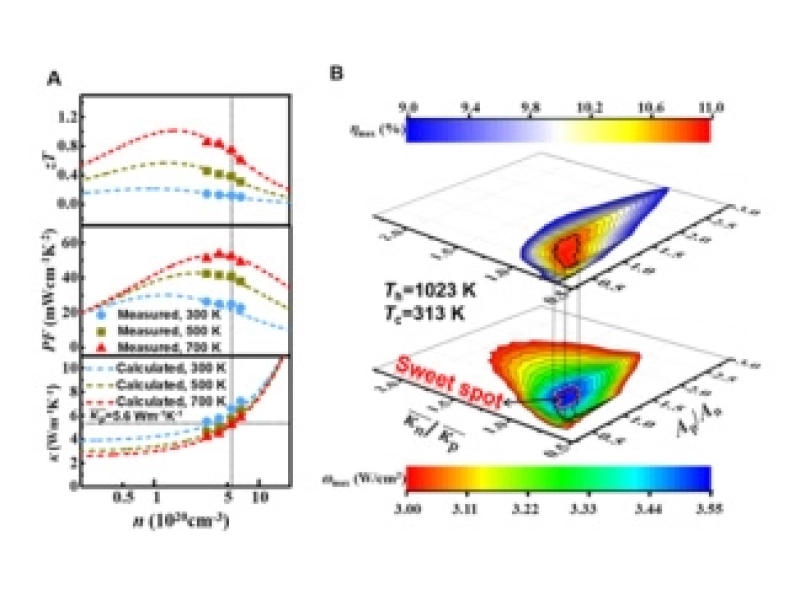
Shanghai Institute of Ceramics Achieves Progress in Thermoelectric Device ResearchSeptember/21/2020
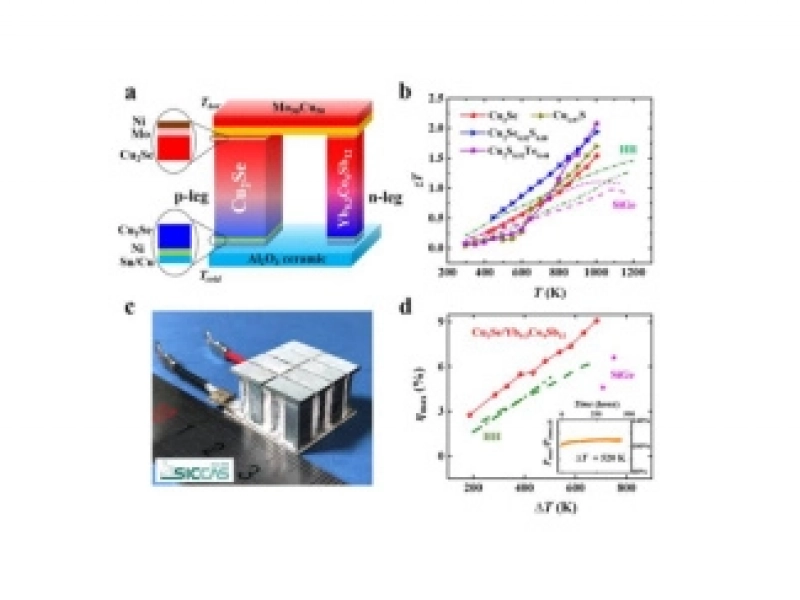
The Shanghai Institute of Ceramics has achieved significant innovative progress in device research on liquid-like thermoelectric materialsMay/31/2019
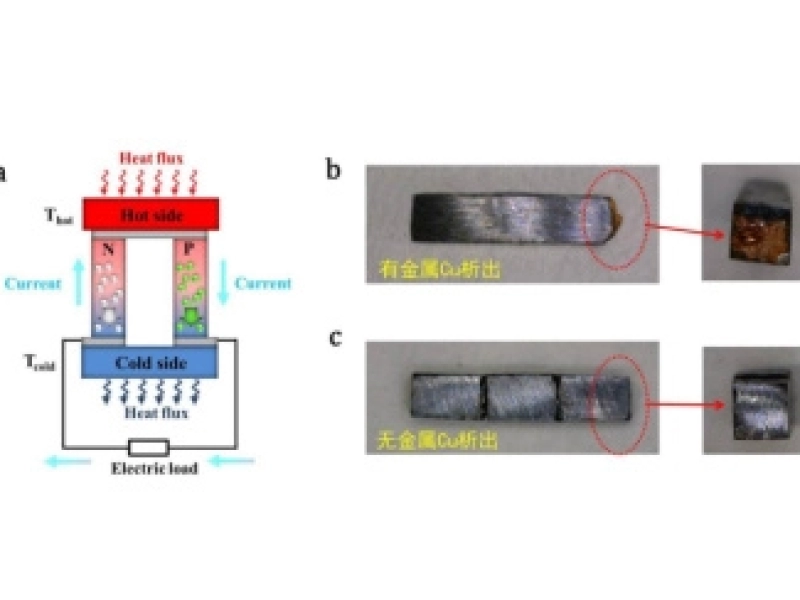
The Shanghai Institute of Ceramics has achieved significant innovative progress in the study of service stability of quasi-liquid thermoelectric materialsJuly/25/2018
The Shanghai Institute of Ceramics has achieved significant innovative progress in the study of thermal conductivity of materials during phase transitionDecember/19/2018