Open Nav


Thermoelectric power generation devices convert heat directly into electricity using the Seebeck effect in semiconductor materials. They are widely used in special space power supplies, industrial waste heat recovery, and other applications. In practical applications, conversion efficiency and power density are key technical indicators in thermoelectric system design. Historically, research on thermoelectric devices has focused on maximizing energy conversion efficiency, while another critical parameter—power density—has often been overlooked. Developing thermoelectric generators with both high conversion efficiency and high power density (“dual-high” performance) has become essential for advancing the practical application of thermoelectric technology.
Traditional research approaches optimize material performance to obtain thermoelectric materials with the highest figure of merit (zT), followed by device structure design to achieve optimal conversion efficiency. This approach separates material optimization and device design into two independent stages: materials research pursues high zT values, while device research uses those materials to maximize efficiency. However, because the electrical and thermal transport properties of high-zT materials are typically fixed, and the structural parameters for maximum efficiency and maximum power density differ, it is difficult to achieve both optimal power density and optimal conversion efficiency in a single device. In practice, achieving high efficiency often requires sacrificing power density, limiting thermoelectric device applications.
Recently, a team led by Researcher Chen Lidong and Senior Engineer Bai Shengqiang from the Shanghai Institute of Ceramics, Chinese Academy of Sciences, in collaboration with Professor Zhu Tiejun from Zhejiang University, proposed a reverse design strategy in which device design guides material optimization. By applying the principles of power-factor priority and thermal conductivity matching, they achieved dual-high device performance.
Using finite-element simulations, the team identified the optimal ranges of thermal conductivity and power factor for matching n-type and p-type half-Heusler materials required for dual-high-performance devices. Based on these results, they tuned the carrier concentration of the n-type material to achieve an optimal power factor and thermal conductivity matching with the p-type material. Without using the highest-zT thermoelectric materials, the device achieved:
The reverse design strategy challenges the traditional research paradigm focused solely on high zT and efficiency, providing a new pathway for designing high-performance, practical thermoelectric devices. This strategy can also be extended to other thermoelectric material systems.
The research was published in Joule (2020, doi: 10.1016/j.joule.2020.08.009).
The work was supported by the National Key R&D Program of China, the National Natural Science Foundation of China, and the Chinese Academy of Sciences Youth Innovation Promotion Association. Direct Ph.D. student Xing Yunfei (Class of 2015) and Associate Researcher Liu Ruiheng are co-first authors.

Thermal Conductivity Matching Design for “Dual-High” Thermoelectric Devices.
(a) Estimated relationships between figure of merit (zT), power factor, thermal conductivity, and carrier concentration.
(b) Maximum power density and maximum conversion efficiency calculated based on the results in (a).

Maximum Conversion Efficiency and Maximum Power Density of Dual-High Thermoelectric Devices Compared with Reported Performance of Single-Stage and Cascaded Thermoelectric Devices (Excluding Single-Leg or Single-Couple Elements)
The Shanghai Institute of Ceramics has achieved significant innovative progress in device research on liquid-like thermoelectric materialsMay/31/2019
The Shanghai Institute of Ceramics has made significant progress in the field of organic-inorganic composite thermoelectric materialsJuly/17/2018
The Shanghai Institute of Ceramics has discovered a semiconductor material with ductility comparable to that of metalsApril/10/2018
The Shanghai Institute of Ceramics has achieved significant innovative progress in the study of thermal conductivity of materials during phase transitionDecember/19/2018
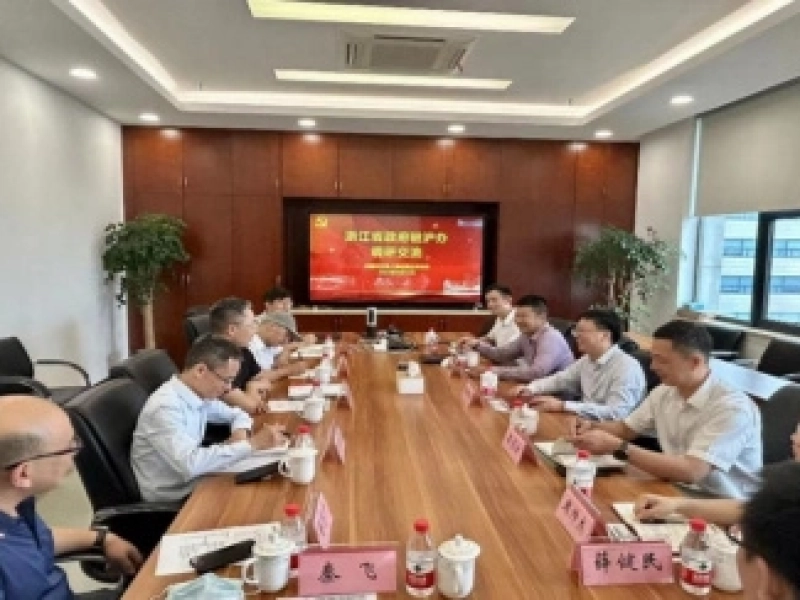
Zhejiang Provincial Government’s Shanghai Office Visits Shanghai Institute of CeramicsSeptember/20/2023