Open Nav


Inorganic plastic thermoelectric materials can overcome the intrinsic brittleness of traditional inorganic thermoelectric compounds and the low electrical transport performance of organic thermoelectric materials, while simultaneously achieving exceptional room-temperature deformability and excellent thermoelectric performance. These materials have broad application prospects in flexible electronics, recovery of waste heat from irregular heat sources, and other areas. In previous studies, the Shanghai Institute of Ceramics, Chinese Academy of Sciences (SICCAS) discovered semiconductor materials with metal-like ductility at room temperature, such as Ag₂S (Nature Materials, 2018), and two-dimensional layered single crystals including InSe (Science, 2020), SnSe₂ (Advanced Science, 2022), and MoS₂ (Nature Communications, 2022), and developed a series of high-performance inorganic plastic thermoelectric materials (Energy & Environmental Science, 2019; Advanced Materials, 2021; Advanced Energy Materials, 2021; Science, 2022, etc.), opening a new research direction in this field. However, the power factor (PF) and thermoelectric figure of merit (zT) of inorganic plastic thermoelectric materials still lag significantly behind traditional rigid thermoelectrics, severely limiting the development and application of high-efficiency flexible thermoelectric devices.
Recently, SICCAS researchers Pengfei Qiu, Xun Shi, and Lidong Chen, in collaboration with Associate Professor Kunpeng Zhao from Shanghai Jiao Tong University, discovered a morphotropic-like phase boundary (MPB) in Ag₂Se–Ag₂S pseudo-binary solid solutions, analogous to the MPB in PZT ferroelectric materials. By precisely tuning the phase structure near the MPB, they simultaneously achieved excellent plasticity and high thermoelectric performance, with the power factor and zT reaching 22 μW·cm⁻¹·K⁻² and 0.61, respectively—both far exceeding previously reported inorganic plastic thermoelectric materials.
Ag₂Se and Ag₂S can form continuous solid solutions. At x ≤ 0.2, Ag₂Se₁₋ₓSₓ exhibits an orthorhombic structure at room temperature; at x ≥ 0.4, it adopts a monoclinic structure. For 0.2 < x < 0.4, the phase structure is highly complex. Using differential scanning calorimetry combined with X-ray diffraction analysis, the team mapped the pseudo-binary phase diagram of Ag₂Se–Ag₂S over the 300–480 K range. When x ≤ 0.2 or x ≥ 0.4, a single phase transition occurs (orthorhombic–cubic and monoclinic–cubic, respectively). However, when 0.2 < x < 0.4, two phase transitions occur: the material transforms from orthorhombic to monoclinic, and then to cubic with increasing temperature. Notably, the orthorhombic–monoclinic phase boundary is slanted rather than linear, similar to the rhombohedral–tetragonal quasi-MPB in PZT. Thermal hysteresis was observed in the cubic–orthorhombic transition for x < 0.4. Theoretical calculations indicate that at S content x = 0.3–0.4, the energies of the orthorhombic and monoclinic phases are comparable, forming a quasi-MPB. Moreover, the anion arrangements in the cubic phase resemble the monoclinic phase but differ greatly from the orthorhombic phase, accounting for the pronounced thermal hysteresis.
Ag₂Se₁₋ₓSₓ pseudo-binary solid solutions exhibit intriguing thermoelectric–mechanical properties near the quasi-MPB. Previous studies showed that monoclinic Ag₂Se₁₋ₓSₓ has good room-temperature plasticity but low PF/zT, while orthorhombic Ag₂Se₁₋ₓSₓ has high PF/zT but is brittle at room temperature. This led to the prevailing belief that achieving both room-temperature plasticity and high PF/zT in Ag₂Se₁₋ₓSₓ was impossible. The current study reveals that the mechanical properties depend on S content rather than crystal structure. At x = 0.25–0.30, the material undergoes a “brittle-to-ductile” transition, allowing the orthorhombic phase near the quasi-MPB to exhibit excellent plasticity, with a three-point bending strain exceeding 15%, enabling the material to bend into various shapes without cracking. This transition arises from a percolating network of multi-center, dispersed Ag–S bonds. Simultaneously, the conduction band carrier effective mass of the orthorhombic phase is only ~1/3 of that of the monoclinic phase, resulting in superior carrier mobility and thermoelectric performance. Thus, near the quasi-MPB, the orthorhombic Ag₂Se₁₋ₓSₓ achieves both excellent room-temperature plasticity and high PF/zT. Its phase space can also be partially tuned via thermal treatment (heating or cooling), greatly expanding the design scope of inorganic plastic thermoelectric materials. At room temperature, the ductile Ag₂Se₀.₆₉S₀.₃₁ orthorhombic phase reaches a power factor of 22 μW·cm⁻¹·K⁻² and zT of 0.61—the highest values reported for plastic materials. This work provides new material support for flexible thermoelectric technologies.
The related research was published in Nature Communications under the title “Modulation of the morphotropic phase boundary for high-performance ductile thermoelectric materials” (2023, doi:10.1038/s41467-023-44318-4). Doctoral graduate Liang Jiasheng and Ph.D. student Liu Jin from SICCAS are co-first authors.
This research was supported by the National Key R&D Program of China, the National Natural Science Foundation of China, and Shanghai Fundamental Research Special Projects.
Link: https://doi.org/10.1038/s41467-023-44318-4

Pseudo-binary Phase Diagram of Ag₂Se–Ag₂S

Relationship between Three-Point Bending Strain and Sulfur Content in Ag₂Se₁₋ₓSₓ Pseudo-Binary Solid Solutions

Thermoelectric Performance of Ag₂Se₁₋ₓSₓ Pseudo-Binary Solid Solutions Near the Quasi-Morphotropic Phase Boundary
The Shanghai Institute of Ceramics has made significant progress in the research on n-type high-performance diamond-like thermoelectric materials.January/06/2018
The Shanghai Institute of Ceramics has discovered a semiconductor material with ductility comparable to that of metalsApril/10/2018
The Shanghai Institute of Ceramics has made significant progress in the field of organic-inorganic composite thermoelectric materialsJuly/17/2018
The Shanghai Institute of Ceramics has achieved significant innovative progress in the study of service stability of quasi-liquid thermoelectric materialsJuly/25/2018
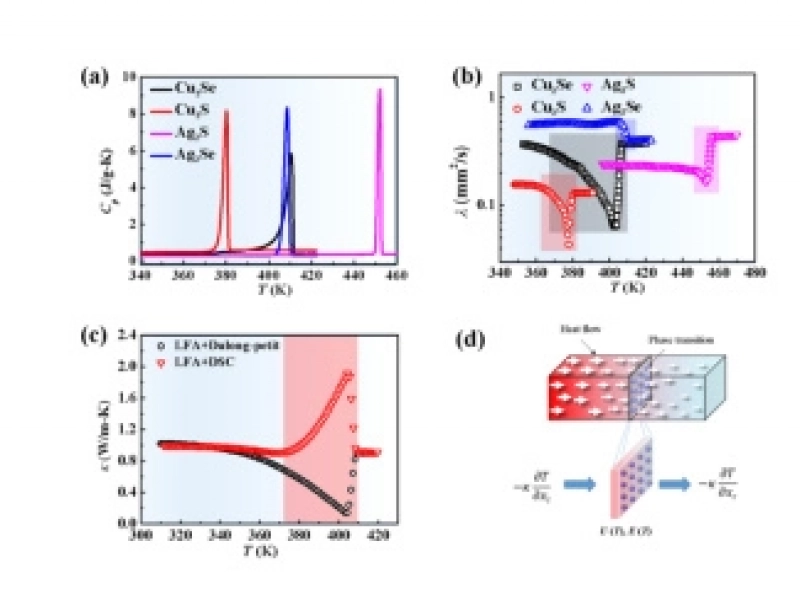
The Shanghai Institute of Ceramics has achieved significant innovative progress in the study of thermal conductivity of materials during phase transitionDecember/19/2018